Gran Canaria · LGBT+ Pride
Maspalomas Pride: the great celebration of southern Gran Canaria
Maspalomas Pride by Freedom is the flagship LGBT+ Pride of southern Gran Canaria and one of the landmark dates on the global calendar. In 2026 it runs from 4 to 10 May, marking its 25th anniversary with a vast parade on Saturday 9 May that draws more than 350,000 people through the streets of Playa del Inglés and Maspalomas. A week of open-air stages, music, revelry and atmosphere centred on the Yumbo Centre, in a destination as easy-going as it is safe.
8 may 2027 · expected
The flagship event
What Maspalomas Pride is
Maspalomas Pride is the LGBT+ Pride festival that, every spring, turns southern Gran Canaria into the epicentre of a celebration with a truly international outlook. Organised by Freedom — hence the full name, Maspalomas Pride by Freedom — it unfolds across a week of open-air stages, live acts, DJ sets and a festive buzz that revolves around the Yumbo Centre and its Plaza de la Diversidad Darío Jaén, in Playa del Inglés.
Its sheer scale speaks for itself: the event brings together more than 350,000 people and generates an estimated economic impact of around 150 million euros for the island. This is no improvised gathering, but the spearhead of a destination officially backed by the Gran Canaria Tourist Board under the Proudly Gran Canaria banner, with almost half a million LGBT+ visitors a year and six decades of history behind it.
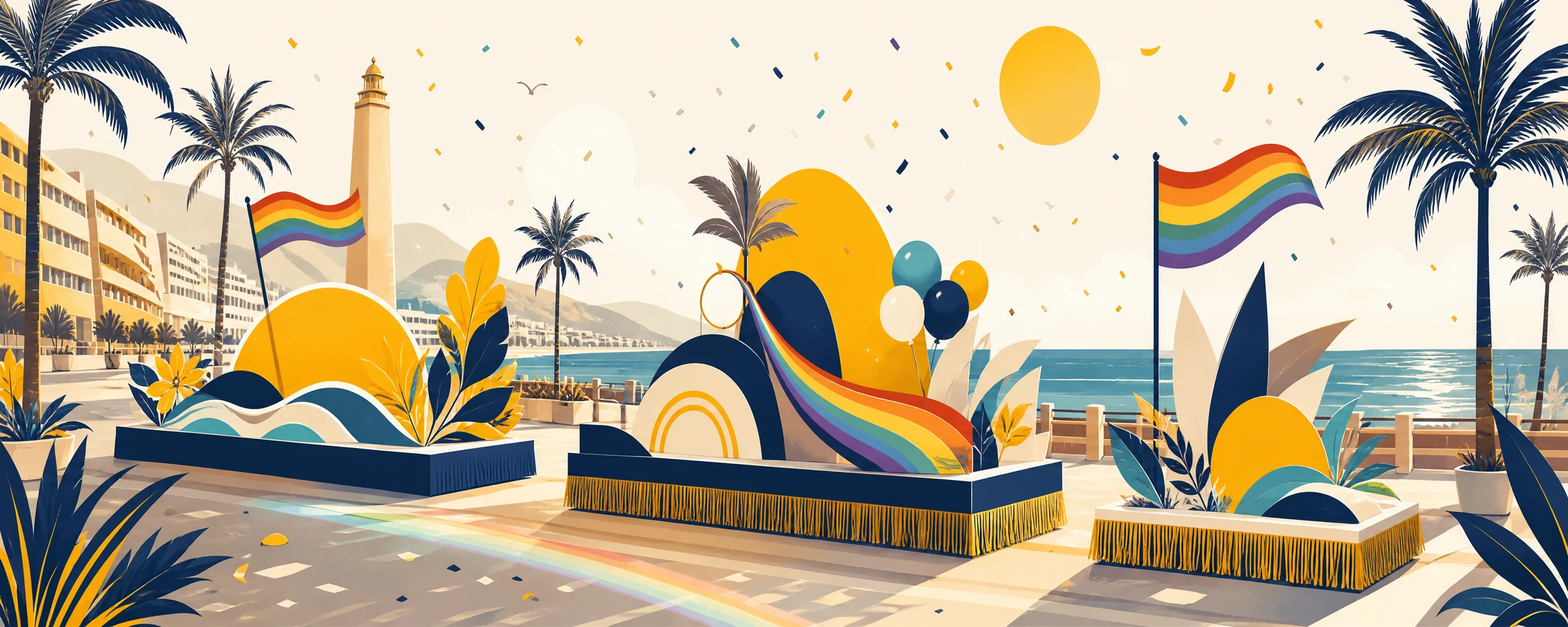
The image that captures its magnitude is the parade, a procession of floats, music and colour that takes over the streets of the resort area and which, in recent editions, has even been broadcast on television. Around that centrepiece unfolds a programme blending revelry, culture and a spirit of togetherness that has become a hallmark of southern Gran Canaria.
Confirmed dates
When Maspalomas Pride 2026 takes place
Maspalomas Pride 2026 runs from 4 to 10 May, an edition of particular significance as it coincides with its 25th anniversary. That means seven days of programming that begin early in the week and build to a peak over the weekend, with the great parade as the centrepiece on Saturday 9 May.
May is, moreover, one of the finest times to visit the south of the island: mild temperatures, a warm sea and the settled climate that has made Maspalomas a year-round destination. It is worth bearing in mind that this is the busiest week of the season for hotels, so booking well ahead makes all the difference.
Looking further ahead, Maspalomas Pride 2027 is expected to fall in the week of 8 May, in line with its usual early-month calendar. This is an estimate that has yet to be officially confirmed: once the organisers publish the definitive dates, this page will reflect them. If you are planning far in advance, treat it as a rough guide rather than a fixed date.
The big day
The great parade on Saturday 9 May
If any single moment captures the spirit of Pride, it is the parade on Saturday 9 May. Floats, choreography, music at full volume and a sea of people sweep through the resort area of Playa del Inglés and Maspalomas in what is, by some margin, the most crowded event of the week and one of the best-attended Pride parades in Europe.
Its reach has grown to the point of reaching the screen: the parade has been broadcast on television, airing on RTVE's La 2, as well as on the platforms of Televisión Canaria (RTVC) and its international channel. It is the clearest proof of just how firmly Maspalomas has established itself as a benchmark, and of how the parade has grown beyond a purely local affair to become a showcase for the destination.
To make the most of it, it pays to stake out a spot in good time along the route, keep hydrated and stay protected from the sun — spring or not, the southern Gran Canaria heat can be fierce — and be patient with getting around, because for those hours the whole area gives itself over to the event.
Practical guide
How to experience it, get there and stay
The heart of Maspalomas Pride beats at the Yumbo Centre, in Playa del Inglés: a calm shopping precinct by day, the absolute epicentre of the scene by night, with its terraces, cabarets and venues spread across several floors. Staying in Playa del Inglés or Maspalomas leaves you a short stroll from the action and the parade route, with barely any need for a car.
Getting there is straightforward. Gran Canaria Airport connects with the whole of Spain and with the event's main European markets — Germany, the United Kingdom and the Nordic countries are among the best represented — and from there the south is just over half an hour away by motorway, whether by hire car, transfer or bus. Once in the area, almost everything is done on foot.
To round off the trip, beyond the festivities: you can book your base in our guide to hotels in the Canary Islands, slip away to the best beaches in Gran Canaria — including the Maspalomas dunes, with their well-known stretch for LGBT+ visitors beside Kiosco 7 — and use the location to discover the south well beyond that single week.
From 2001 to today
The history of Pride in Maspalomas
Maspalomas Pride as we know it today was born in 2001, but its roots reach back much further. As early as the 1960s and 1970s, southern Gran Canaria began to emerge as a European gay destination, drawn by a climate of between 18 and 25 degrees for practically the whole year, which meant the sun could be enjoyed even in the depths of winter.
The turning point came with the opening of the Yumbo Centre in October 1982, a space that would in time become the only LGBTI leisure shopping centre in the world and the anchor of the area's nightlife. Shortly afterwards, in 1986, the Maspalomas Carnival introduced its celebrated Drag Gala, another of the great landmarks of Canarian festive culture, which links directly to our coverage of the Maspalomas Carnival and the Las Palmas Drag Gala.
On those foundations, a Pride of its own was built in 2001, one that in barely two decades has taken on a global dimension. Today, alongside the Pride in May, the southern calendar adds events throughout the year — from November's Winter Pride to the spring and end-of-year festivals — within an ecosystem set in a country at the top of the European LGBTI rights ranking (ILGA-Europe), with marriage equality since 2005. A destination, in short, as celebrated as it is safe.
Plan your trip
Get your Maspalomas getaway ready
FAQ
Common questions
When is Maspalomas Pride 2026?
Maspalomas Pride by Freedom takes place from 4 to 10 May 2026, coinciding with its 25th anniversary. The great parade, the centrepiece, is held on Saturday 9 May. For 2027, the week of 8 May is expected, though this is an estimate that has yet to be officially confirmed.
Where is it held?
In southern Gran Canaria, in the municipality of San Bartolomé de Tirajana, centred on the Yumbo Centre in Playa del Inglés. The parade runs through the resort area of Playa del Inglés and Maspalomas, and the atmosphere concentrates around the venues of the Yumbo and its surroundings.
When and what is the parade like?
The parade is the most crowded moment of the week and takes place on Saturday 9 May 2026. It brings together more than 350,000 people with floats, music and a procession through the streets of the resort area. It pays to stake out a spot in good time along the route, keep hydrated and stay protected from the sun.
Is there an entry fee, or is it free?
The parade and the street atmosphere are free and open to all: they can be enjoyed throughout the resort area without a ticket. Some specific parties and events on the programme may require a separate ticket or pass; it is worth checking the official programme for each edition for those particular events.
How do you get to Maspalomas Pride?
The most common route is to fly into Gran Canaria Airport, well connected with Spain and with the event's main European markets. From there, the south is little more than half an hour away by motorway, whether by hire car, transfer or bus. Once in Playa del Inglés or Maspalomas, almost everything is done on foot.
Is it broadcast on television?
Yes. The parade and several galas have been broadcast on Televisión Canaria (RTVC) and its international channel, and the parade has aired on RTVE's La 2 — proof of the reach the event has achieved well beyond the island.