Gran Canaria · Maspalomas LGBT+
Gay Gran Canaria: the complete guide to Maspalomas, the Yumbo and the whole LGBT+ scene
Maspalomas, in the south of Gran Canaria, is one of the world's leading LGBT+ destinations and the epicentre of gay tourism in the Canary Islands. Six decades of history, official backing from the Tourism Board under the "Proudly Gran Canaria" brand, an 18-25 °C climate all year round and a one-of-a-kind infrastructure — starting with the Yumbo Centre, the only LGBTI leisure and shopping centre in the world — have made it a magnet that welcomes close to 500,000 LGBT+ visitors a year, some €600 million and around 15% of the island's tourism business. Add to that an almost monthly calendar of events — from Maspalomas Pride in May to Winter Pride in November — and the setting of a country that tops the European ranking on LGBTI rights. In short: guaranteed sunshine, a scene concentrated in a single area and a genuine sense of freedom twelve months of the year.
2 nov–8 nov 2026
22° in Maspalomas now · High UV (7) · Sea 25°
The guide
Explore Maspalomas by topic
Maspalomas Pride
The big May Pride: parade, dates and full guide.
Read more →Winter Pride
The winter Pride in the sun, in November.
Read more →Yumbo Centre
The heart of the scene, the only LGBTI leisure centre in the world.
Read more →Gay beach
The Maspalomas dunes, Kiosco 7 and the live weather.
Read more →Gay hotels
Where to stay near the Yumbo, by micro-area.
Read more →Bear Carnival
Europe's biggest bear gathering, every spring at the Yumbo.
Read more →LGBT+ calendar
All the year's events, month by month.
Read more →All year round
The Maspalomas Pride calendar
World-class destination
Why Maspalomas is a top-tier LGBT+ destination
The story begins in the 1960s and 70s, when the south of Gran Canaria started to draw the first gay travellers from across Europe: a corner of the Atlantic with temperatures of 18 to 25 °C all year round, picture-postcard dunes and a discretion that, under the dictatorship of the day, was almost unheard of. That seed took firm root in the 1980s. In October 1982 the Yumbo opened its doors; in 1986 the Maspalomas Carnival launched its Drag Gala (the legendary "Miss Traveskarnatival"); and in 2001 Maspalomas Pride was born. Each milestone cemented an identity that is today a name recognised right across Europe.
The figures confirm the destination's weight. Maspalomas welcomes around 500,000 LGBT+ visitors a year, who leave behind close to €600 million and account for roughly 15% of all tourism business in Gran Canaria. The source markets paint a distinctly European picture: Spain (19%), Germany (14%), the United Kingdom (13%), Sweden (7%) and Denmark (6%) lead the way.
What sets it apart from other destinations is the institutional backing. The Gran Canaria Tourism Board champions the "Proudly Gran Canaria" brand, with a presence at international trade fairs and a sustained commitment to the segment. This is not a scene that merely survives on the margins: it is a deliberate tourism policy, with six decades of experience behind it.
The epicentre
The Yumbo Centre: the heart of the scene
If Maspalomas has a centre of gravity, it is the Yumbo Centrum, in Playa del Inglés. Opened in 1982, it is recognised as the only LGBTI leisure and shopping centre in the world, and its double life is part of its charm: by day it is a shopping and family centre, with shops, restaurants and quiet terraces; as night falls it becomes the epicentre of the scene, with more than 50 venues — bars, cabaret rooms, drag shows and clubs — spread across its floors.
The complex has also taken on a symbolic value over the years. Its Plaza de la Diversidad Darío Jaén pays tribute to the community's memory and its struggle, and it is a regular meeting point during the year's big events. The Yumbo thus works as the destination's main square: the place everyone comes back to, whether for a midday coffee or the last drink of the small hours.
Its compact layout is also a practical advantage for visitors. Almost the entire nightlife scene fits within a single building, which makes a car unnecessary and makes it easy to move on foot between very different venues in the course of a single evening.
Sun and dunes
The gay beach among the Maspalomas dunes
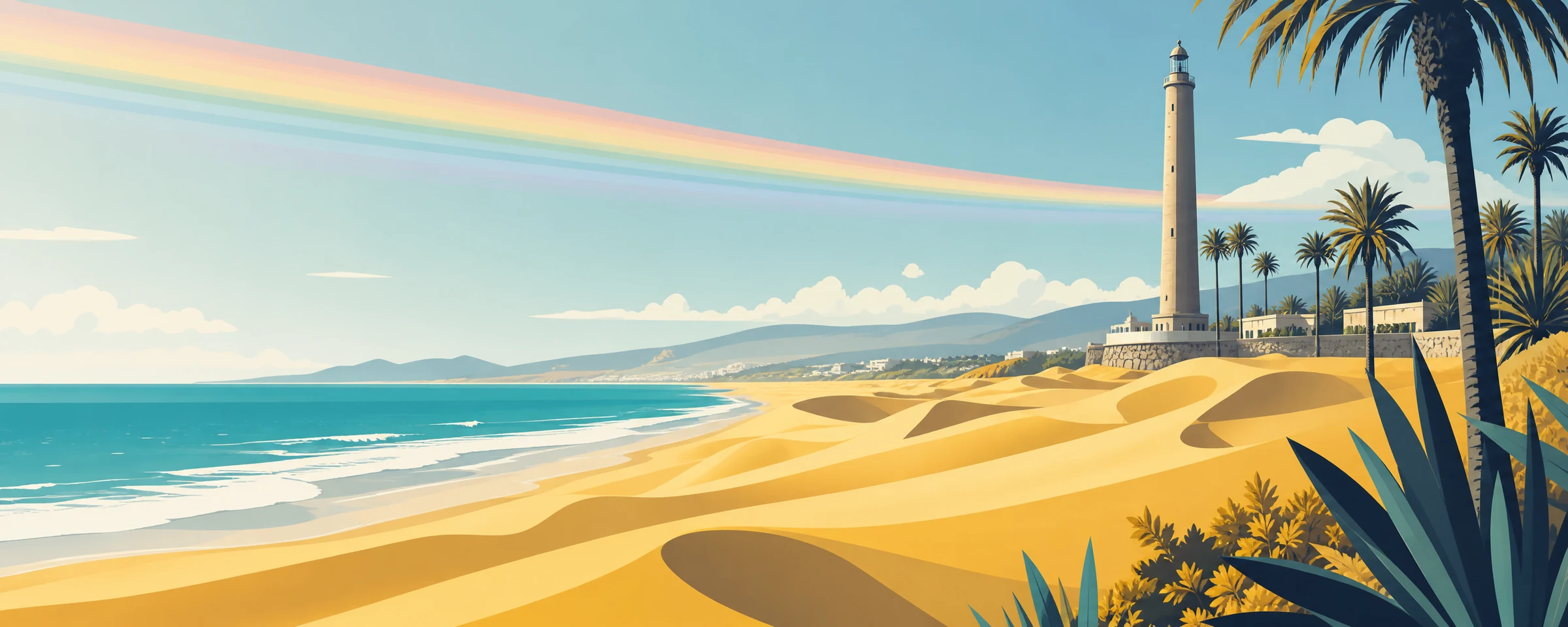
The go-to bathing spot stretches between the Maspalomas dunes and Playa del Inglés, one of the most iconic landscapes in the south of the island. The classic meeting point is the area around Kiosco 7, a landmark familiar to several generations of travellers, with a stretch of naturist area woven into the dune landscape.
The appeal goes beyond the scene itself: the Maspalomas dunes are a protected natural space of the finest sand and ever-shifting contours, and the walk down to the shore is part of the experience. It is worth remembering the basics of any beach of this kind — staying hydrated, wearing sun protection and respecting the dune environment — so you can enjoy it sensibly. If you want to explore more of the coastline, our guide to the beaches of Gran Canaria covers the finest coves and stretches of sand across the whole island.
All year round
An almost monthly calendar of events
Few destinations offer such a continuous line-up. The year kicks off in the Carnival months, when the island's biggest celebration intertwines with drag culture: the Las Palmas Drag Queen Gala (20 February 2026) and the Maspalomas Drag Gala (26-27 March) are two of the most spectacular shows on the calendar, broadcast on television and followed by huge audiences. You can find more context in our guides to the Maspalomas Carnival and the Las Palmas Drag Gala, part of the wider Canary Islands Carnival.
The rest of the year keeps up the pace. The Bear Carnival brings more than 3,000 people together at the Yumbo (19-29 March 2026); Maspalomas Pride by Freedom marks its 25th anniversary in 2026 (4-10 May, with the parade on Saturday the 9th), an event that draws more than 350,000 attendees, generates some €150 million and is even broadcast on RTVE's La 2. Come autumn and winter, the calendar rolls on with the Freedom Festival (October), the Maspalomas Fetish Pride (1-5 October), Winter Pride — more than 40,000 people under the "winter sun" of around 23 °C (2-8 November) — and the Freedom New Year Festival (28 December-1 January). Looking ahead to 2027, Maspalomas Pride is expected around the week of 8 May, though this is not yet officially confirmed.
Where to stay
The ideal area: Yumbo and Playa del Inglés
The advice is simple: the closer to the Yumbo and Playa del Inglés, the better. This is the area with the liveliest scene, the widest choice of nightlife and the best walking links to the LGBT+ heart of the destination, which means you can leave the car behind for a night out. Many of the surrounding bungalow complexes and hotels cater explicitly to this clientele, with options that range from the quiet and family-friendly to the outright party-focused.
The south of Gran Canaria offers accommodation for every style and budget, from dune-side apartments to landmark hotels. It is well worth booking ahead for the big dates — Pride in May and Winter Pride in November account for the year's peak demand. Compare your options in our guide to hotels in the Canary Islands to find the area and type of property that best suits your trip.
A safe destination
Gran Canaria, a destination with every guarantee
Beyond the scene and the climate, there is one decisive factor: safety. Spain tops the ILGA-Europe ranking on LGBTI rights in Europe and has had marriage equality since 2005, a legal framework that translates into everyday normality and genuine institutional support for the destination. This is no brochure detail: it is what allows you to stroll, celebrate and travel with complete peace of mind.
That combination — a solid legal framework, six decades of tourism tradition and a community used to welcoming travellers from all over Europe — explains why Maspalomas keeps its place among the world's most highly regarded LGBT+ destinations. Here, diversity is not a seasonal label but part of the landscape all year round.
FAQ
Questions about gay Gran Canaria
Which is the gayest island in the Canaries?
Gran Canaria, without question, and specifically Maspalomas (in the municipality of San Bartolomé de Tirajana, in the south of the island). It is one of the world's leading LGBT+ destinations, with six decades of history, official backing from the Tourism Board under the "Proudly Gran Canaria" brand and close to 500,000 LGBT+ visitors a year.
Where is the LGBT+ scene in Gran Canaria?
The heart of the scene is the Yumbo Centre (Yumbo Centrum), in Playa del Inglés: a shopping and family centre by day, and by night the epicentre of LGBT+ nightlife, with more than 50 venues — bars, cabaret rooms, drag shows and clubs. Practically all of the nightlife is concentrated within a single complex.
When is the best time to visit?
Any time, because the climate hovers around 18-25 °C all year round. Even so, the big dates bring the liveliest atmosphere: Maspalomas Pride in May, Winter Pride in November (with its "winter sun" of around 23 °C) and the Carnival drag galas between February and March. If you're after the greatest buzz, aim for those weeks; if you prefer things quieter, any other month works just fine.
Is Gran Canaria safe for LGBT+ tourism?
Yes. Spain tops the ILGA-Europe ranking on LGBTI rights in Europe and has had marriage equality since 2005. To that legal framework you can add six decades of tourism tradition and a community used to welcoming travellers from all over Europe, which makes for a well-established, safe destination.
Where is the gay beach in Maspalomas?
Between the Maspalomas dunes and Playa del Inglés, with the area around Kiosco 7 as the go-to meeting point and a stretch of naturist area woven into the dune landscape. Getting there involves a walk across the dunes, a protected natural space that is part of the appeal.
What is the Yumbo?
The Yumbo Centrum is a shopping centre in Playa del Inglés that opened in October 1982, recognised as the only LGBTI leisure and shopping centre in the world. It is home to more than 50 venues, and its Plaza de la Diversidad Darío Jaén is a symbolic meeting point for the community. It works as a family shopping centre by day and the epicentre of the scene by night.