Canarias.app travel guide · El Hierro
What to See in El Hierro: A Complete Guide to the Meridian Island
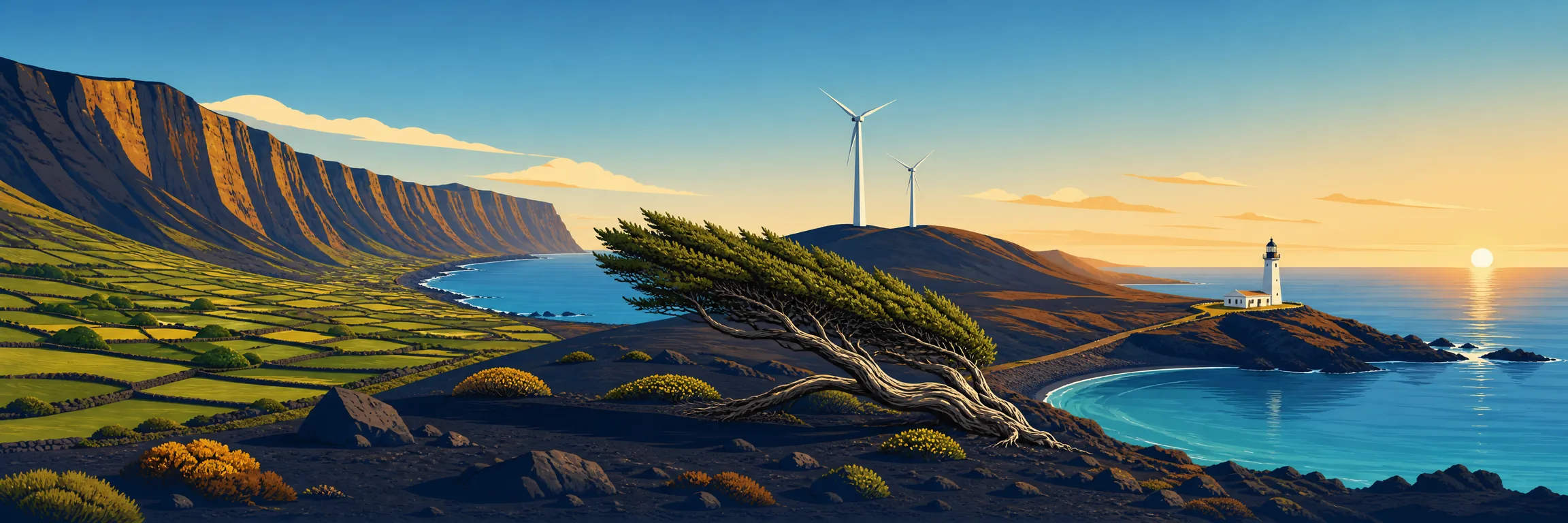
El Hierro is the smallest and youngest of the Canary Islands, a UNESCO Biosphere Reserve and Global Geopark with 60% of its land protected. People don't come here for the sand. They come for volcanic rock pools, world-class diving in the Mar de las Calmas and footpaths that wind between juniper trees bent flat by the trade winds. This is the island of the Meridian and of the Gorona del Viento renewable-energy project: nature at its purest, free of the crowds, with a character all of its own.
What to see
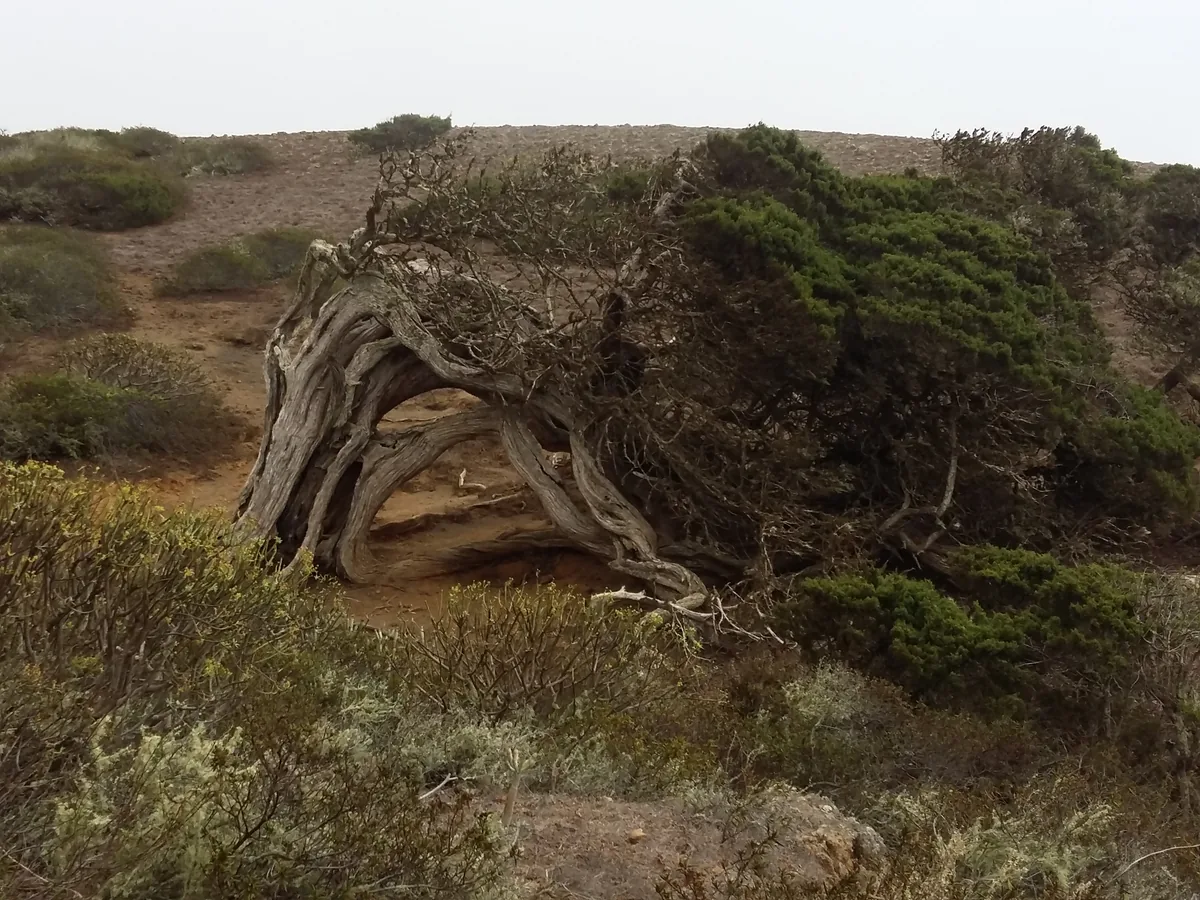
The Mirador de la Peña, a César Manrique creation in Guarazoca, frames the classic view of the El Golfo valley, a vast natural amphitheatre of cliffs nearly 1,000 m high that opens onto the sea, carved out by a landslide some 15,000 years ago. Over in La Dehesa, El Sabinar is home to gnarled juniper trees twisted almost to the ground by the wind, standing beside the hermitage of the Virgen de los Reyes. Don't miss the Faro de Orchilla (once the site of the prime meridian), the sacred Garoé tree that the Bimbache people relied on to draw water from the mist, or the Guinea Eco-Museum with its enclosure for the rare giant lizard. La Llanía, set among laurel forest and old craters, is one of the island's most spellbinding walks.
Beaches and natural pools
El Hierro's signature is its volcanic rock pools, not its sand. The ones not to miss: La Maceta and the Charco Azul in El Golfo, with turquoise basins and walkways; the Pozo de las Calcosas in the north, tucked among stone cottages; and Tacorón, a sheltered cove ideal for snorkelling, close to La Restinga. Tamaduste is a protected, lagoon-like inlet that's perfect for families. For actual sand, there are only two practical choices: Timijiraque (black sand, on the east coast) and El Verodal (reddish sand, in the west, with currents). One key warning: many of the pools depend on a calm sea, and a northerly swell can make them dangerous, so it's well worth checking the sea conditions first.
Getting around
Hiring a car is strongly recommended: the island is made for exploring at your own pace, and public transport is limited. Distances are short but the roads are mountainous, full of bends and tunnels, so it pays to allow plenty of time (it's 26 km and about 30 minutes from the airport to Frontera, and 41 km and nearly an hour to La Restinga). The TransHierro buses run 12 routes linking the main settlements, though services are infrequent and geared more towards residents. There's a 24-hour taxi service, including a wheelchair-accessible vehicle, with rough fares of around €28–30 from the airport to Frontera and €48–52 to La Restinga. Fill up in good time: petrol stations are few and close early.
When to go and the climate
El Hierro enjoys a mild subtropical climate all year round, with little variation between the seasons. The real contrast comes down to altitude and aspect: the north (Valverde, El Golfo) is wetter, cooler and cloudier thanks to the trade winds and its trademark sea of clouds, while the south (La Restinga, Mar de las Calmas) is warmer, drier and sunnier. For diving and swimming, the water is at its warmest from June to November, peaking in September and October. For walking, spring and autumn are ideal. Whatever the time of year, pack a light layer for the evenings and the higher ground, and it's worth chasing that sea of clouds from the Jinama or La Peña viewpoints.
Where to stay
The choice is small and full of character, the result of a deliberately limited approach to tourism: rural hotels, stone cottages, apartments, a campsite and the Parador de El Hierro. To pick an area: Valverde, Tamaduste and Echedo (north-east) make a practical base, close to the airport and the harbour; El Golfo, Frontera and Tigaday (west) offer a green valley, natural pools and local wine, a very well-rounded central base; and La Restinga (south) is essential if you've come to dive. At Las Playas, at the foot of the cliffs, you'll find the Parador and the famous Hotel Punta Grande, known for being among the smallest hotels in the world. In Sabinosa, the Pozo de la Salud spa is renowned for its historic mineral-medicinal waters.
Food and tips
The star product is El Hierro cheese, often smoked with fig wood, heather or prickly pear, an international award-winner, along with its sweet counterpart, the quesadilla. Pair it with El Hierro DO wine (full-bodied whites in particular), fresh fish with wrinkly potatoes and mojo, limpets, octopus, and hearty inland dishes such as watercress stew, puchero, or goat with gofio. There's even pineapple grown in El Golfo. A few practical pointers: book your car and ferry well ahead in high season, carry some cash as some businesses don't take cards, and respect the surroundings (a Biosphere Reserve and a marine reserve). The clear skies also make this a wonderful place for stargazing.
FAQ
Questions about What to See in El Hierro
How do you get to El Hierro?
There are two options. By air, into Valverde airport (VDE), which is served only by Binter inter-island flights from Tenerife North and Gran Canaria (around 35–40 minutes), so coming from mainland Spain or abroad means changing planes. By sea, the Los Cristianos (Tenerife) to Puerto de la Estaca route takes about 2 hours 20 minutes, run by Naviera Armas and Fred. Olsen, a handy choice if you want to bring your own car. It's worth checking timetables, as they vary by season.
Does El Hierro have sandy beaches?
Very few. The real swimming here is in the volcanic rock pools, such as La Maceta, the Charco Azul, the Pozo de las Calcosas and Tacorón. For sand, there are only two practical options: Timijiraque, with black sand in the east, and El Verodal, with reddish sand in the west, the latter with currents that mean you should swim with care. Before getting into any pool, check that the sea is calm, especially when there's a northerly swell.
Why is El Hierro famous for diving?
Because of the Mar de las Calmas marine reserve in the south-west, which sits sheltered from the trade winds and offers an exceptionally calm sea. La Restinga is regarded as the diving capital of the Canaries, with visibility of up to 30 m, water between 18 and 25°C all year round, and volcanic seabeds that have come back to life since the 2011 eruption. You can spot groupers, barracudas, turtles and, occasionally, whale sharks. The standout dive is El Bajón, an underwater seamount.
How many days do you need to see El Hierro?
With 3 or 4 days you'll get a good feel for the island: one day for El Golfo with its viewpoints and pools, another for La Dehesa (the Sabinar, the Faro de Orchilla and the hermitage), one for walking in La Llanía or around Valverde and the Garoé, and another for diving or swimming in the south. If you're coming to dive seriously in La Restinga, it's worth setting aside more days. This is an island to take slowly, with no rush.
What is Gorona del Viento and why is it worth seeing?
It's the hydro-wind power station that aims to supply the island with 100% renewable electricity. It combines five wind turbines (11.5 MW) with a pumped-storage system: when there's surplus wind, water is pumped up into a crater turned reservoir; when the wind drops, the water runs back down through a turbine to generate power. It has managed to meet the island's entire demand from renewables alone for weeks at a stretch. It's the great symbol of El Hierro as a sustainable island, and one more reason to visit.
Make the most of your visit
Tickets, tours and activities
There are excursions, guided tours and activities in El Hierro to round off your visit to Qué ver en El Hierro.
See tours and activitiesKeep exploring
More to see in El Hierro
Tours and activities in El Hierro
Loading tours…