Canarias.app travel guide · Fuerteventura
El Cotillo (Fuerteventura): beaches, lagoons, lighthouse and surf
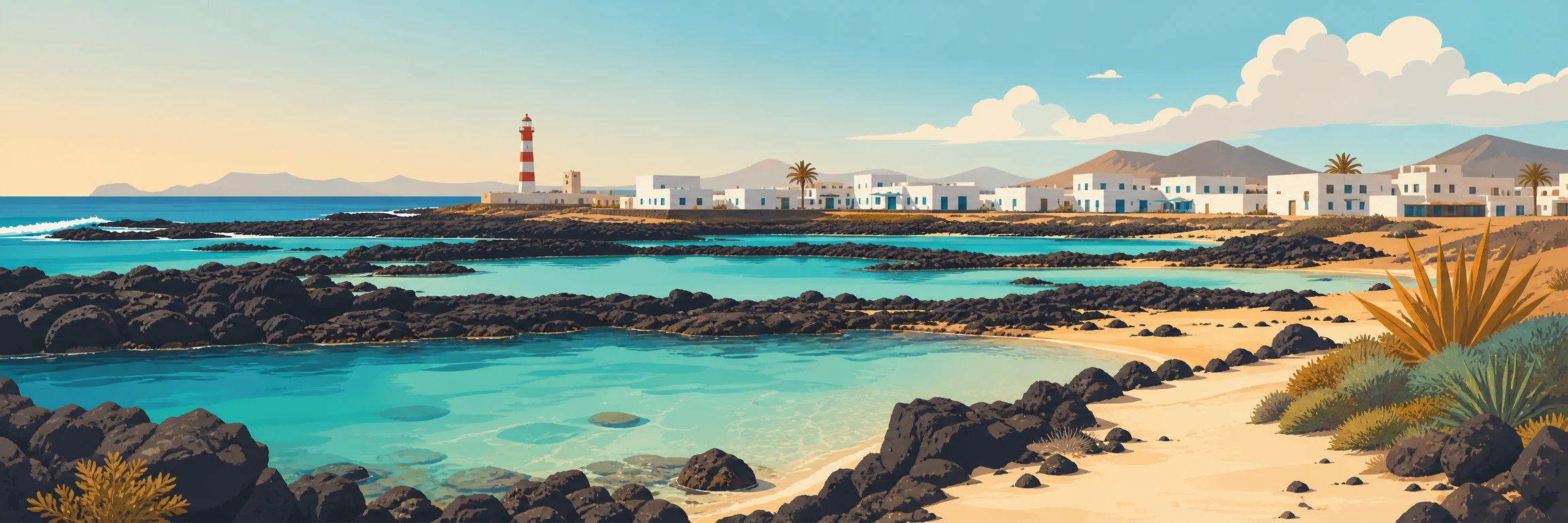
El Cotillo packs two sides of Fuerteventura into just a few kilometres: turquoise, family-friendly lagoons to the north and open surf beaches to the south. Add a fishing village, the Toston lighthouse, the defensive tower and west-coast sunsets. Choose your area according to the tide, wind and the kind of swim you want.
A fishing village between two coasts
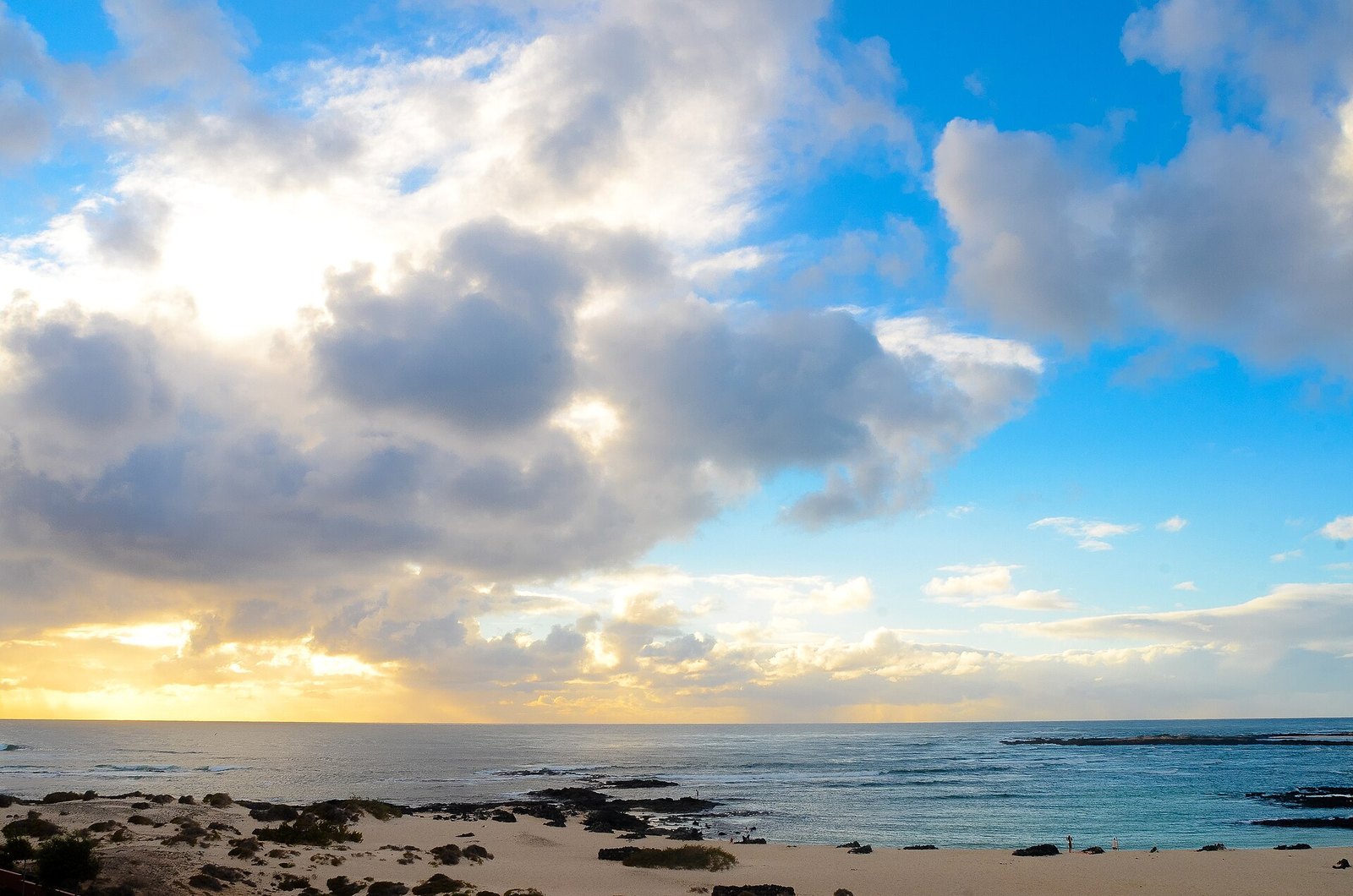
El Cotillo sits on the north-western tip of Fuerteventura, in the municipality of La Oliva, and still keeps the scale of a fishing village in its harbour, white houses and fish restaurants. Its appeal is not one single beach, but the contrast. To the north, around La Concha and Los Lagos, there are lagoons and natural pools of turquoise water, protected by volcanic reefs and far more comfortable for family swimming. To the south, about a kilometre from the village, Piedra Playa, also known as Playa del Castillo, changes the mood completely: sand, gravel, rounded stones, wind and stronger surf, classic terrain for surfing, windsurfing and kitesurfing. This double identity avoids confusion. El Cotillo is not only a quiet bathing spot, nor only a sports beach; it is an easy base for combining calm water, village life, lighthouse, defensive tower and sunset. Reading it this way helps avoid sending families to beaches that clearly belong to surf territory.
Northern lagoons and Playa de la Concha
The natural pools of El Cotillo lie north of the village, before the Toston lighthouse, around La Concha and Los Lagos. They are pools and lagoons formed by volcanic rock reefs, which soften the swell and create clear, shallow and generally calm water. For families, this is the sector to prioritise, while still watching the sea state and the tide. La Concha, with its sheltered shape and fine sand, is the best-known cove for a relaxed swim. The experience changes greatly with the tide: at mid to high tide the sea enters gently and fills the lagoons; at very low tide there may be more sand than useful bathing water. There is little natural shade, so a parasol, water and sun cream are essentials, not extras. Volcanic rock can cut or become slippery; water shoes help. If the wind is strong, look for lower sheltered corners and avoid walking barefoot on rock.
Lighthouse, tower and harbour quarter
North of the village, a good dirt track of a few kilometres leads to the Toston lighthouse on Punta de La Ballena. The setting combines black volcanic rock, open horizon and views towards the Bocaina strait between Fuerteventura and Lanzarote. The lighthouse forms part of a triangle of maritime signals with the Martino lighthouse on Lobos and the Pechiguera lighthouse on Lanzarote; it has also had three successive towers, from the original late-19th-century structure to the current one, built in the 1980s. In the village itself, the Torre or Castillo del Toston recalls the island’s coastal defence: it was rebuilt around 1700 on the site of an earlier tower and has been listed as a Historic-Artistic Monument since 1949. A walk through the old harbour and the El Roque area completes the visit without turning it into a race. At sunset, this stretch becomes especially striking and does not need a long visit. Go with enough daylight to spare.
Surf to the south, calmer water to the north
The practical rule in El Cotillo is simple: north for sheltered bathing, south for wave sports. Piedra Playa, also called Playa del Castillo, is an open, windy beach with stronger surf; that is why it attracts surfers, windsurfers and kitesurfers, especially when powerful swell arrives. It is not the right place for children or unsure swimmers, and at many times it has no direct lifeguard cover. The northern lagoons offer a gentler sea, but they should not be treated like artificial pools: tides change depth and currents, and volcanic rock demands attention. If you are coming from Corralejo, you can link both worlds of northern Fuerteventura: Corralejo for dunes and ferries to Lobos, El Cotillo for lagoons, lighthouse and surf. The sister page for Corralejo is What to see in Corralejo. The tide decides how enjoyable each individual lagoon will be.
How to get there and when it is worth it
A car is the most convenient way to arrive. From Corralejo it is about 18-20 kilometres via the FV-101/FV-10 axis, passing through Lajares, while from Puerto del Rosario the distance is around 40 kilometres. Buses do connect with Corralejo and the capital, although frequencies can be limited and should be checked before planning. Free parking is available on dirt areas beside the village, lagoons and lighthouse, without expecting major infrastructure. Late afternoon has a clear advantage: El Cotillo faces west, so sunsets over the Atlantic are part of the trip. If the day is very windy, the lagoons and some coves beneath the cliffs are usually more sensible than the open beaches. For the Traditional Fishing Museum at the lighthouse, do not rely on fixed opening times or prices; confirm before going whether it is open and under what conditions. Plan the return in daylight if you go out to the lighthouse by track.
FAQ
Questions about El Cotillo
Where are the natural pools of El Cotillo?
North of the village, around La Concha and Los Lagos, before the Toston lighthouse. They are turquoise lagoons protected by volcanic reefs; they change a lot with the tide, so mid to high tide is usually the better moment.
Is El Cotillo a good option with children?
Yes, if you choose the northern lagoons, especially La Concha and Los Lagos, where the water is usually calmer. Avoid the open southern beaches, such as Piedra Playa, because they are windier, with waves and currents that are less suitable for children swimming.
What can you see at the Toston lighthouse?
The Toston lighthouse stands on the northern point, surrounded by black volcanic rock and open views across the Bocaina strait. It houses the Traditional Fishing Museum, although opening and conditions should be checked before going. From outside, the setting alone is worth the detour.
Is El Cotillo good for surfing?
Yes. The open beaches south of the village, especially Piedra Playa or Playa del Castillo, are classic spots for surfing, windsurfing and kitesurfing. They are windy, wave-exposed areas, made more for sport than for calm swimming on suitable days.
Can you visit El Cotillo from Corralejo in a day?
Yes. They are about 18-20 kilometres apart and combine well on a northern route. Corralejo brings dunes, atmosphere and access to Lobos; El Cotillo adds lagoons, lighthouse, fishing-village character and sunset without a major detour.
Make the most of your visit
Tickets, tours and activities
There are excursions, guided tours and activities in Fuerteventura to round off your visit to El Cotillo.
See tours and activitiesKeep exploring
More to see in Fuerteventura
Tours and activities in Fuerteventura
Loading tours…