Canarias.app travel guide · Fuerteventura
Fuerteventura Travel Guide: What to See, Best Beaches, When to Go and Getting Around
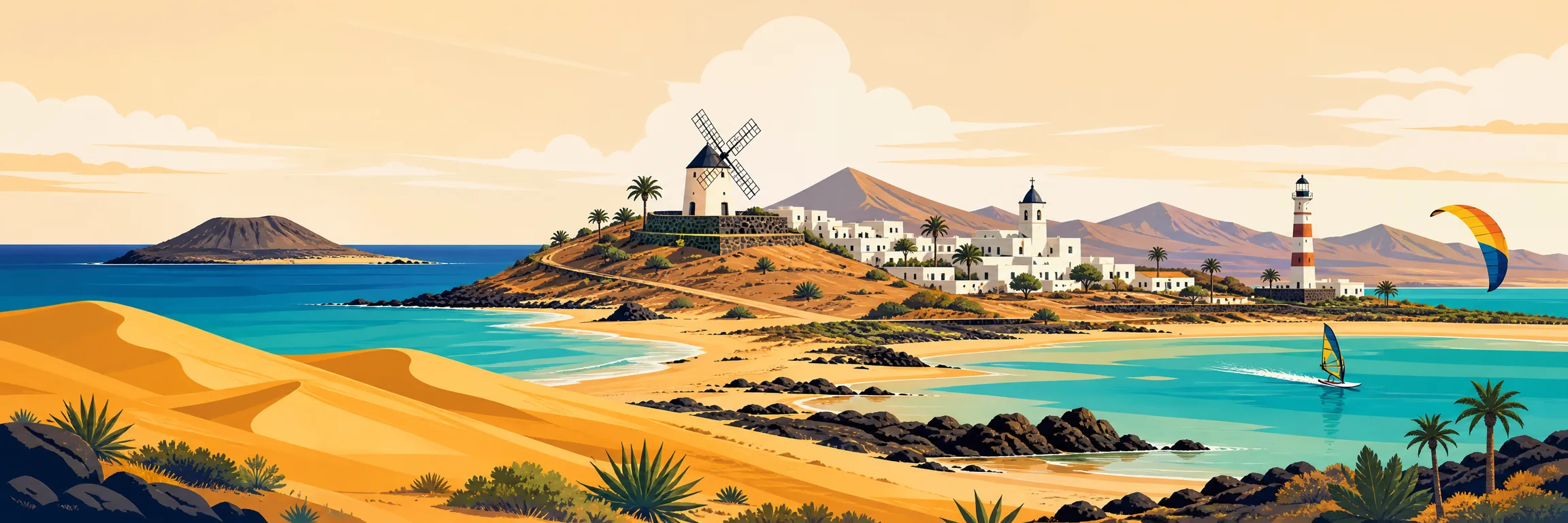
Fuerteventura is the oldest and most African of the Canary Islands: an arid landscape of white dunes, endless plains and more than 150 beaches that add up to nearly 77 kilometres of sand. The archipelago's second-largest island is famous for its steady trade winds — making the Sotavento coast a world capital of windsurfing and kitesurfing — and for an eternal-spring climate with almost 3,000 hours of sunshine a year. A UNESCO Biosphere Reserve since 2009, it pairs raw nature (Cofete, Lobos, the Corralejo dunes) with the tradition of majorero cheese, the first goat's cheese in Spain to earn protected designation of origin.
The Must-See Sights
The Corralejo Dunes Natural Park spreads 2,600 hectares of shifting white sand alongside the turquoise Grandes Playas, the largest beaches in the archipelago. Down south, Cofete beach unfurls twelve kilometres of untouched sand beneath the Jandía massif, reached only by a dirt track of roughly 18 kilometres from Morro Jable (a 4x4 is best, and swimming is not advised because of the currents). Betancuria, the first capital, founded by Jean de Béthencourt in 1404, still keeps its church of Santa María and the Morro Velosa viewpoints. Rounding off the list are the islet of Lobos, the Ajuy Caves with their black sand and fossilised dunes, the Tostón lighthouse at El Cotillo, and Pico de la Zarza, the island's highest point at 813 metres.
The Best Beaches
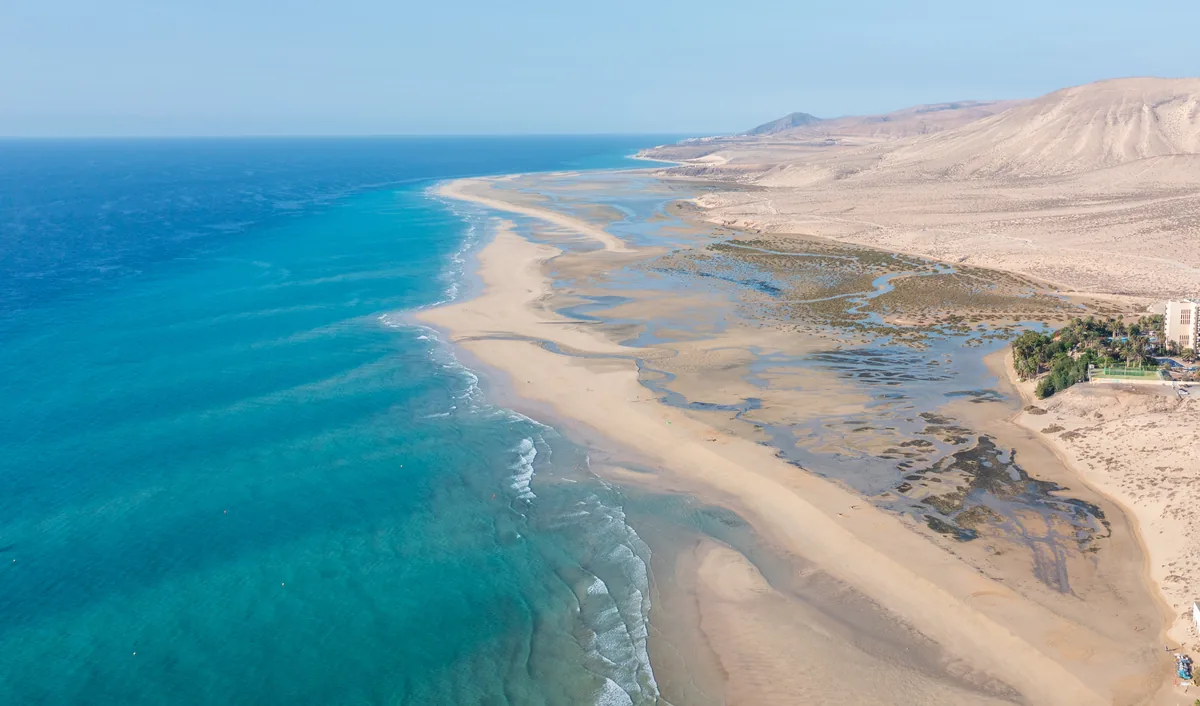
Sotavento, on the Jandía peninsula, is the jewel: kilometres of golden sand where the falling tide forms a huge shallow lagoon, safe for beginners and home to the Windsurfing and Wingfoil World Cup. Corralejo's Grandes Playas dazzle with turquoise water lapping right up to the dunes. El Cotillo offers the best of both worlds — sheltered reef-protected coves of crystal-clear water, and Playa del Castillo to the south for surfing. Cofete is the wild option, perfect for a walk but not for swimming. And scattered between them all lie the unspoilt coves of the Jandía peninsula. It pays to check the tide tables before you set off: the lagoons at El Cotillo and Sotavento only form at low tide.
Getting Around
Fuerteventura Airport (FUE, El Matorral) links the island to more than a hundred destinations and handled close to seven million passengers in 2025; it sits about five kilometres from Puerto del Rosario on the FV-2 motorway. TIADHE buses (known locally as guaguas) cover the main routes: line 6 connects the capital with Corralejo, and line 10 runs south to Morro Jable via Costa Calma. A ticket from the airport costs around 1.40 euros to the capital and roughly 9.30 euros to Morro Jable. Even so, a car is all but essential for reaching Cofete, El Cotillo or the interior: the road network is easy to drive, with two clear axes (the FV-1 in the north, the FV-2 in the south) and plenty of roundabouts. Fuel works out notably cheap thanks to the Canary Islands' tax regime.
When to Go and the Climate
Fuerteventura is a year-round destination: a hot, arid climate with barely 147 millimetres of rain a year and almost 3,000 hours of sunshine. In winter highs hover around 22 degrees and in summer around 28, with a mild sea all year. The trade winds blow constantly and pick up in summer, which is what makes it a paradise for windsurfing and kitesurfing — though you'll want to anchor your parasol firmly in August. Winter is high season, with Europeans escaping the cold; summer dodges the crowds in exchange for stronger winds. The best balance of good weather, pleasant water and fewer people comes in September and October. Occasional spells of Saharan calima (dust haze) can roll in.
Where to Stay by Area
Corralejo, in the north, is the liveliest base: right by the dunes and the Grandes Playas, with an old quarter, restaurants and nightlife, and ideally placed for visiting Lobos and El Cotillo. Caleta de Fuste, in the centre, is the closest to the airport — quiet and family-friendly, with resorts and good connections. In the south, Costa Calma and Morro Jable concentrate kilometres of white-sand beach, relaxed hotels and access to the wind sports and to Cofete. El Cotillo, in the north-west, offers a surfer's escape and turquoise coves with fewer tourists. Puerto del Rosario, the capital, is the practical urban choice. For stays of more than a week, the ideal is to split your days between north and south.
Food and Practical Tips
The star of the show is majorero cheese, holding protected designation of origin since 1996 as Spain's first goat's cheese with a PDO: it's made from the milk of the native majorera goat, a breed that grazes among cardón cacti and tabaiba shrubs, and comes soft, semi-cured or cured, sometimes with the rind rubbed in gofio, paprika or oil. The majorero table is rounded out with goat meat, Canarian puchero stew, sancocho, papas arrugadas with mojo, and fresh fish in the fishing villages of El Cotillo and Morro Jable. Two practical tips: to visit the islet of Lobos you'll need a free advance permit applied for online, with a limited time-slot pass; and at Cofete, check that your rental insurance covers driving on dirt tracks.
FAQ
Questions about Fuerteventura Travel Guide
When is the best time to visit Fuerteventura?
It's a year-round destination, but the best balance of good weather, pleasant water and fewer crowds comes in September and October. Winter is high season as Europeans escape the cold, with highs around 22 degrees; summer avoids the crowds in exchange for stronger winds, which is ideal for water sports.
Do you need a hire car in Fuerteventura?
TIADHE buses cover journeys between the capital, Corralejo and the south well enough, but a car is practically essential for reaching Cofete, El Cotillo or the interior. The road network is easy to drive and fuel is cheap thanks to the Canary Islands' tax regime. For the track to Cofete a 4x4 is advisable, and do check that your insurance covers dirt roads.
Can you visit the islet of Lobos freely?
No. For some years it has been compulsory to apply for a free advance permit online to control visitor numbers and protect the ecosystem. The pass allows a limited time slot and a small number of people per booking. The ferry from Corralejo can usually arrange the permit along with your ticket; it's worth checking the day's availability before you go.
What are the best beaches in Fuerteventura?
Sotavento, on the Jandía peninsula, is the most famous for its shallow lagoon and its status as a world capital of windsurfing and kitesurfing. Corralejo's Grandes Playas stand out for their turquoise water beside the dunes, while El Cotillo combines family-friendly reef-protected coves with waves for surfing. Cofete is the great wild beach, perfect for a walk, though swimming is not advised because of the currents.
What should you eat in Fuerteventura?
The essential is majorero cheese, Spain's first goat's cheese with a protected designation of origin, made from the milk of the native goat and available soft, semi-cured or cured. Majorero cooking is rounded out with goat meat, Canarian puchero stew, sancocho, papas arrugadas with mojo, and fresh fish and seafood in fishing villages such as El Cotillo and Morro Jable.
Make the most of your visit
Tickets, tours and activities
There are excursions, guided tours and activities in Fuerteventura to round off your visit to Guía de Fuerteventura.
See tours and activitiesKeep exploring
More to see in Fuerteventura
Tours and activities in Fuerteventura
Loading tours…