Canarias.app travel guide · Fuerteventura
Betancuria in Fuerteventura: What to See, History and How to Get There
Betancuria is the former capital of Fuerteventura, founded in 1404 in a sheltered inland valley. A visit brings together historic church, museums, ruined convent and stone-built old town, with the viewpoints along the FV-30 as natural stops before or after the village. It is an inland visit best done without rushing and with opening times confirmed in advance.
The old capital in a valley of stone
Betancuria is best understood before you arrive: the FV-30 road twists through the central massif and drops into a dry valley, enclosed by bare hills, where the village keeps an almost hamlet-like scale. Jean de Béthencourt founded it in 1404, seeking distance from the coast and a degree of protection from pirate attacks, and from here Fuerteventura’s political life was organised until 1834. Today it should not be treated as a frozen postcard, but as a small historic centre of stone, courtyards, gardens and cut-stone corners that explains a central part of the island. It is also the least populated municipality in the Canary Islands, with fewer than 1,000 residents, so the rhythm feels very different from Corralejo or Jandía. The visit calls for slow walking, narrow streets and an understanding that its value lies in the whole: inland landscape, memory of conquest, religious architecture and the silence of a Majorero valley. That is why it works so well as a heritage pause on a route through the island’s inland viewpoints.
Church, museums and convent
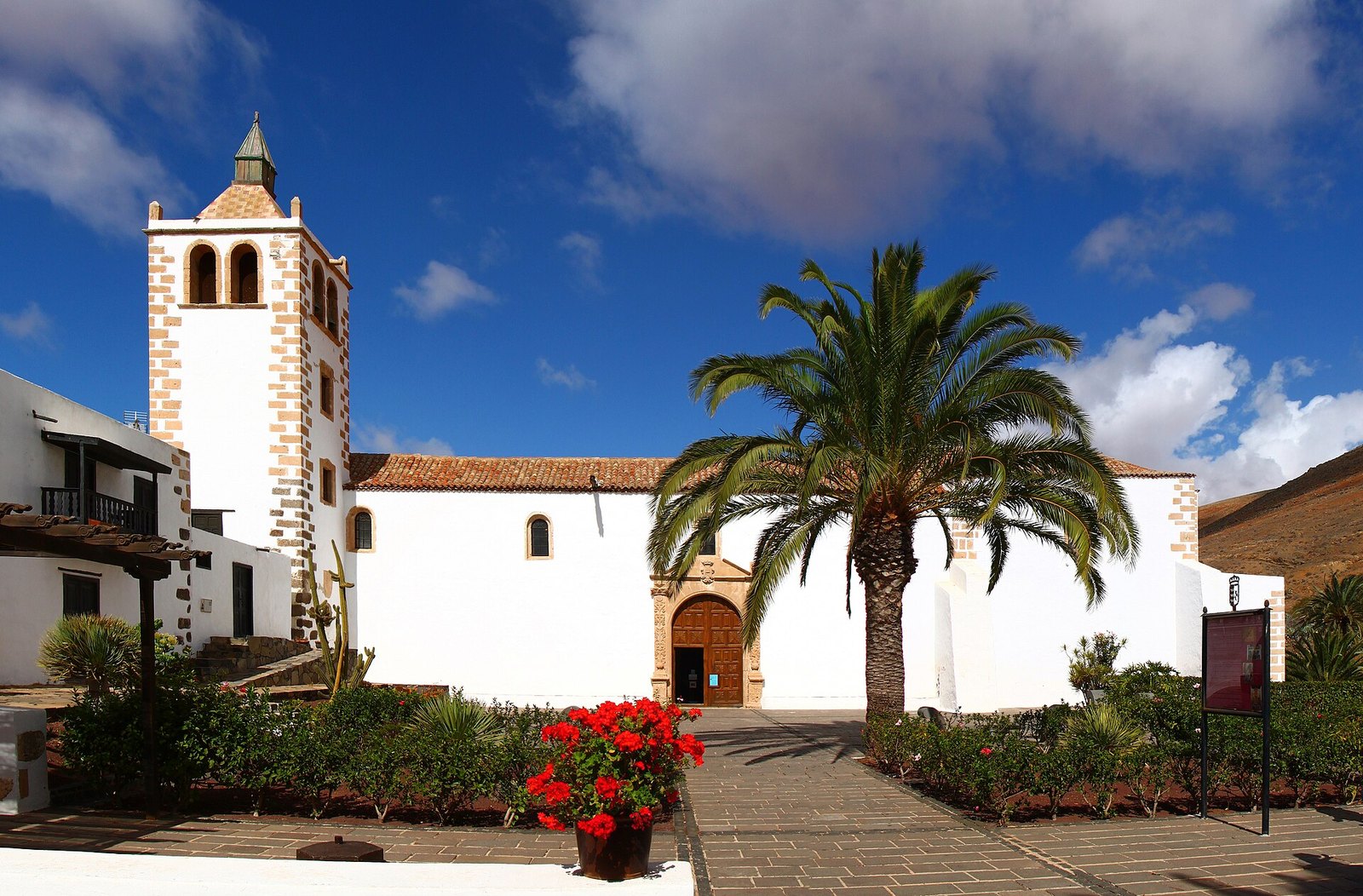
The church of Santa María, also known as Iglesia Matriz de la Concepción, is Betancuria’s great landmark. Its origins date to 1410, although the current building reflects later reconstructions after the sack of 1593: three naves, Baroque altarpieces, Mudéjar wooden ceiling, pulpit and a square tower that dominates the old town. The village was also, briefly, an episcopal seat, and its church once held cathedral rank in the early years of the Canarian diocese. Beside the church is the Museo de Arte Sacro, with liturgical pieces from the 15th century onwards, and on Calle Roberto Roldán the Museo Arqueológico y Etnográfico, focused on the material culture of the majos and island life. A short distance away stand the roofless ruins of the Convento de San Buenaventura, with walls recalling the first Franciscan establishment on the island. If the interior is closed, the exterior and its setting still convey the historical scale.
How to get there via the FV-30
From Puerto del Rosario, Betancuria is around 20 kilometres by road. The usual route takes the FV-2 south and, at the Antigua junction, joins the FV-30, a narrow, winding road that crosses the massif before descending into the village. It is a short distance, but not a route to rush: there are changes in gradient, wind on the high ground and cyclists on some stretches. On the same road are two stops that should be treated as part of the approach, not as substitutes for the visit: the Mirador de Guise y Ayose, with bronze sculptures of the ancient Indigenous kings, and the turn-off to Mirador Morro Velosa. The difference is clear: Morro Velosa is a panoramic balcony over the massif; Betancuria is the historic village in the valley below, with church, museums, convent and old town. Make the stops before parking if you are descending with good light to spare.
When to go and how to plan the visit
Morning is usually the best time for Betancuria: there is less heat, a better chance of finding the church and museums open, and less pressure from excursions arriving during the day. Do not plan the visit around a single photograph; allow time to enter the church if it is open, see at least one museum and walk down towards the convent ruins. Opening hours and admission for the church and museums vary by season and may differ between sources, so the sensible approach is to confirm them with the town hall or tourist office before going. As this is not a beach destination, tides and swimming do not matter here: sun, shade and driving matter more. Take water, a hat and sun protection, as the streets and surroundings offer little shade. If you are touring the centre-west, it combines well with Vega de Río Palmas, the Ermita de Santa Inés and the viewpoints on the same FV-30. That way you avoid arriving when interiors have already closed or paused.
A history of raids and a brief bishopric
Betancuria’s history is unusually dense for such a small village. In 1424, Pope Martin V created a bishopric with its seat in the village, suppressed only a few years later, around 1431, so Betancuria was an episcopal seat for a brief period. Its harshest episode came in 1593, when the Berber corsair Xabán Arráez devastated the town, destroyed the church and convent and took dozens of residents captive. This explains why the main building is a reconstruction and why documents from 16th-century Fuerteventura were lost. The visit gains depth when told this way: not as a pretty backdrop, but as a place that was a capital, a religious centre, a target of attacks and a living archive of an island that looked inland to survive. Told in that frame, the stop gains weight without turning historical doubt into certainty or loading it with legend.
FAQ
Questions about Betancuria in Fuerteventura
Why was Betancuria the capital of Fuerteventura?
Because Jean de Béthencourt founded it in 1404 in an inland valley, away from the coast, seeking protection from pirate attacks. It was the capital of Fuerteventura until 1834, when the seat moved to Antigua, and it retains a very visible historical and ecclesiastical importance.
What can you see in Betancuria?
The church of Santa María, the Museo de Arte Sacro, the Museo Arqueológico y Etnográfico, the ruins of the Convento de San Buenaventura and the stone-built historic centre. On the FV-30, before descending to the village, are the viewpoints of Guise y Ayose and Morro Velosa.
Who founded Betancuria and in what year?
It was founded by the Norman conqueror Jean de Béthencourt in 1404, during the Castilian conquest of the Canary Islands. It is considered one of the first settlements founded in the archipelago after the conquest and shaped Fuerteventura’s early organisation.
How do you get to Betancuria from Puerto del Rosario?
By car, taking the FV-2 south and joining the FV-30 at Antigua. It is around 20 kilometres, but the final stretch crosses a mountain pass with bends, occasional wind and slow traffic, so it is best driven calmly.
Do you need to book admission for the church or museums?
The church and museums may charge admission, and their opening hours vary by season or temporary closure. Before planning the day, confirm opening and conditions with the town hall, tourist office or the site itself.
Make the most of your visit
Tickets, tours and activities
There are excursions, guided tours and activities in Fuerteventura to round off your visit to Betancuria.
See tours and activitiesKeep exploring
More to see in Fuerteventura
Tours and activities in Fuerteventura
Loading tours…