Canarias.app travel guide · Lanzarote
César Manrique in Lanzarote: a route through all his works
César Manrique, born in Arrecife in 1919 and killed in Tahíche in 1992, returned to Lanzarote in 1966 with a defining idea: to fuse art and nature. His imprint can be seen in Jameos del Agua, Mirador del Río, Jardín de Cactus, Fundación César Manrique, Casa-Museo de Haría, MIAC and other spaces.
Who César Manrique was, and why Lanzarote looks the way it does
César Manrique was a painter, sculptor and total artist, born in Arrecife in 1919 and killed in a road accident in Tahíche in 1992. After years in Madrid and New York, he returned to Lanzarote in 1966 with an idea that would shape the island: art and nature should be understood as one. His influence left a visible legacy: a Lanzarote without high-rise towers or advertising billboards, with whitewashed houses and green or blue woodwork. That imprint is not confined to visitor centres or museums. It affects the way the island is viewed, built and presented to travellers. A Manrique route is therefore not just a sequence of tickets, museums and viewpoints. It is a way of understanding why Lanzarote has such a recognisable aesthetic identity. His interventions connect volcanic tubes, cliffs, gardens, vernacular architecture, museums and harbour spaces under one idea of integration with the island landscape.
His essential works, one by one
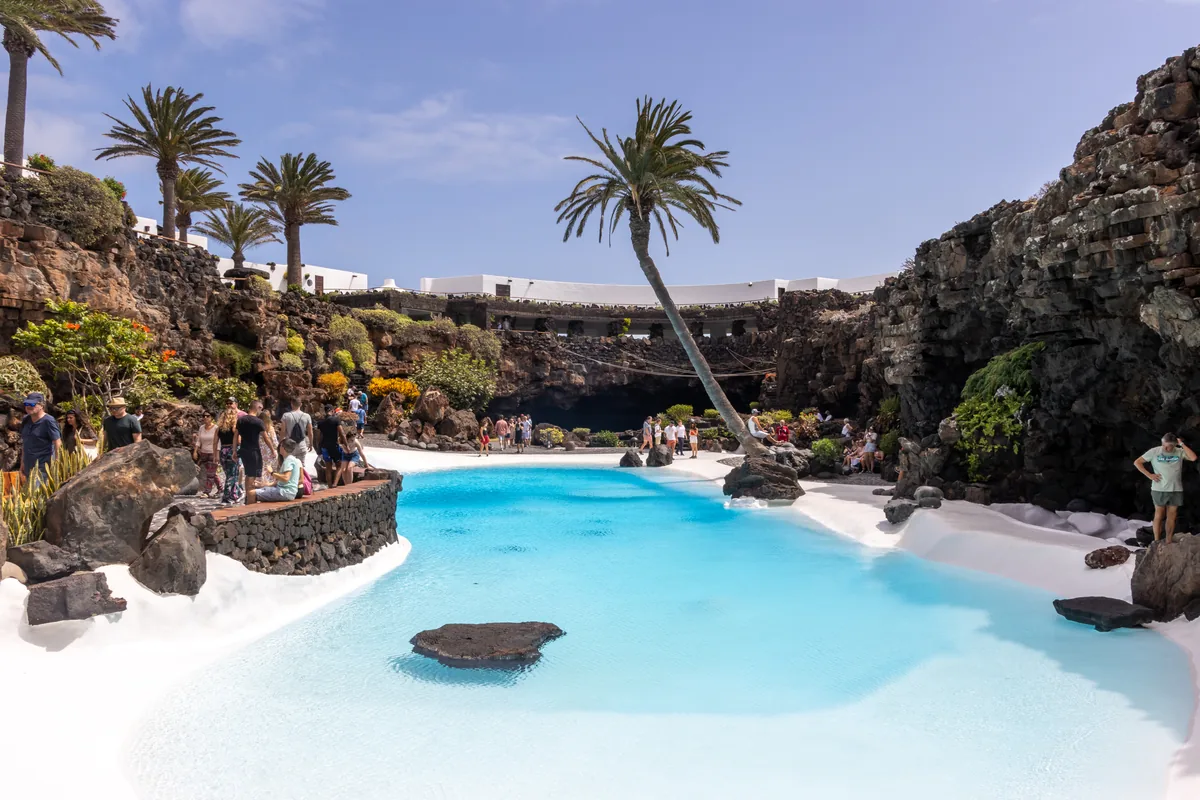
The visitable works of César Manrique in Lanzarote form a broad network, most of them within the CACT network and with paid entry, so it is worth checking official opening times before planning the route. Jameos del Agua was his first major intervention and sits inside a volcanic tube. Mirador del Río occupies a high position above the Risco de Famara. Jardín de Cactus, in Guatiza, was his final major work, completed in 1990. Casa-Museo del Campesino and the Monumento a la Fecundidad are in San Bartolomé. In Timanfaya, El Diablo appears as both restaurant and symbol of the park. In Arrecife, his footprint runs through the MIAC in the Castillo de San José and the Charco de San Ginés. The list shows the breadth of his work: volcano, cliff, garden, rural culture, contemporary art, port city and tourism symbols folded into a single narrative.
Fundación César Manrique: the house in Tahíche
César Manrique’s house in Tahíche, built over five volcanic bubbles, is now the Fundación César Manrique. That fact makes it a central stop for understanding the way he worked with lava and domestic space: this is not a museum placed inside any convenient building, but a home integrated into a volcanic structure. The Foundation expresses very clearly the idea Manrique defended on returning to Lanzarote in 1966: art and nature as one thing. On a route through his works, Tahíche helps connect the biography with the landscape. It does not replace Jameos del Agua, Mirador del Río or Jardín de Cactus, but it offers a more direct reading of his life and of the way he intervened in the territory. Check official information before visiting, especially if you are combining it with other centres on Lanzarote.
The Casa-Museo de Haría
The Casa-Museo de Haría was César Manrique’s last home and preserves his studio intact. That detail sets it apart from the Tahíche Foundation: here the focus is on the artist’s final period, in a setting of palms and rural life in northern Lanzarote. Haría, known as the valley of a thousand palms, provides a very different frame from the volcanic tubes, cliffs and harbour spaces where he also left his mark. The visit reveals a more intimate side of his career, linked to his last years before his death in Tahíche in 1992. On a Manrique route, the Casa-Museo de Haría works especially well after you have understood his broader influence on the island: no high-rises, no advertising billboards, and an aesthetic of white houses with green or blue woodwork. Check official information before going to confirm current visiting conditions.
How to organise a Manrique route in one or two days
A Manrique route is best organised by area and by type of experience. In one day, choose several nearby or complementary works rather than trying to cover the whole island without pause. Jameos del Agua and Mirador del Río combine naturally with the volcanic north and the Risco de Famara; Jardín de Cactus is in Guatiza; Casa-Museo de Haría adds the final home and intact studio. Tahíche, with the Fundación César Manrique, brings in the house over five volcanic bubbles and can act as the biographical centre of the route. Arrecife adds the MIAC in the Castillo de San José and the Charco de San Ginés, two urban traces of the artist. With two days, it is more sensible to separate the north, Tahíche and Arrecife, leaving room for San Bartolomé, where the Casa-Museo del Campesino and the Monumento a la Fecundidad are located. Most centres may require paid entry and official timetables.
His imprint beyond Lanzarote
Although Lanzarote concentrates the most recognisable part of his legacy, César Manrique also left his mark on other Canary Islands. Those works include Lago Martiánez in Puerto de la Cruz, Tenerife; Mirador de la Peña in El Hierro; and Mirador del Palmarejo in La Gomera. This wider reach helps explain that his influence was neither purely local nor limited to a Lanzarote aesthetic. His way of working with landscape, architecture and the tourist gaze continued beyond his native island. Even so, Lanzarote remains the territory where his idea is perceived most clearly: the absence of high-rise buildings and advertising billboards, the white houses with green or blue woodwork, and the network of visitable works form a whole that is difficult to separate. Including the pieces on other islands only really makes sense if you are extending the journey across the Canaries; to understand him at the root, Lanzarote is the natural starting point.
FAQ
Questions about César Manrique in Lanzarote
Which works by César Manrique can be visited today?
In Lanzarote you can visit Jameos del Agua, Mirador del Río, Jardín de Cactus, Casa-Museo del Campesino, Fundación César Manrique, Casa-Museo de Haría, the MIAC in the Castillo de San José and other spaces linked to his imprint on Arrecife and the island.
Where did César Manrique live?
His house over five volcanic bubbles in Tahíche is now the Fundación César Manrique. His final home was the Casa-Museo de Haría, in northern Lanzarote, where the studio remains intact and that last stage of the artist’s life can be visited.
What is the difference between the Foundation and the Casa-Museo de Haría?
The Fundación César Manrique is in Tahíche, in his house built over five volcanic bubbles. The Casa-Museo de Haría was his last home and preserves his studio intact, connected to his final years in the valley of a thousand palms.
Book online
Tickets, tours and activities
César Manrique en Lanzarote is a paid attraction: booking your tickets in advance secures your spot and usually skips the ticket-office queue.
Buy tickets for César Manrique en LanzaroteKeep exploring
More to see in Lanzarote
Tours and activities in Lanzarote
Loading tours…