Canarias.app travel guide · Lanzarote
Teguise, the former capital of Lanzarote: guide to the historic town
The Villa de Teguise was capital of Lanzarote from the 15th century until 1852 and preserves a historic centre of white mansions, convents and elegant squares. On Sunday mornings it hosts the busiest market in the Canary Islands, so arriving early is wise.
Four centuries as capital
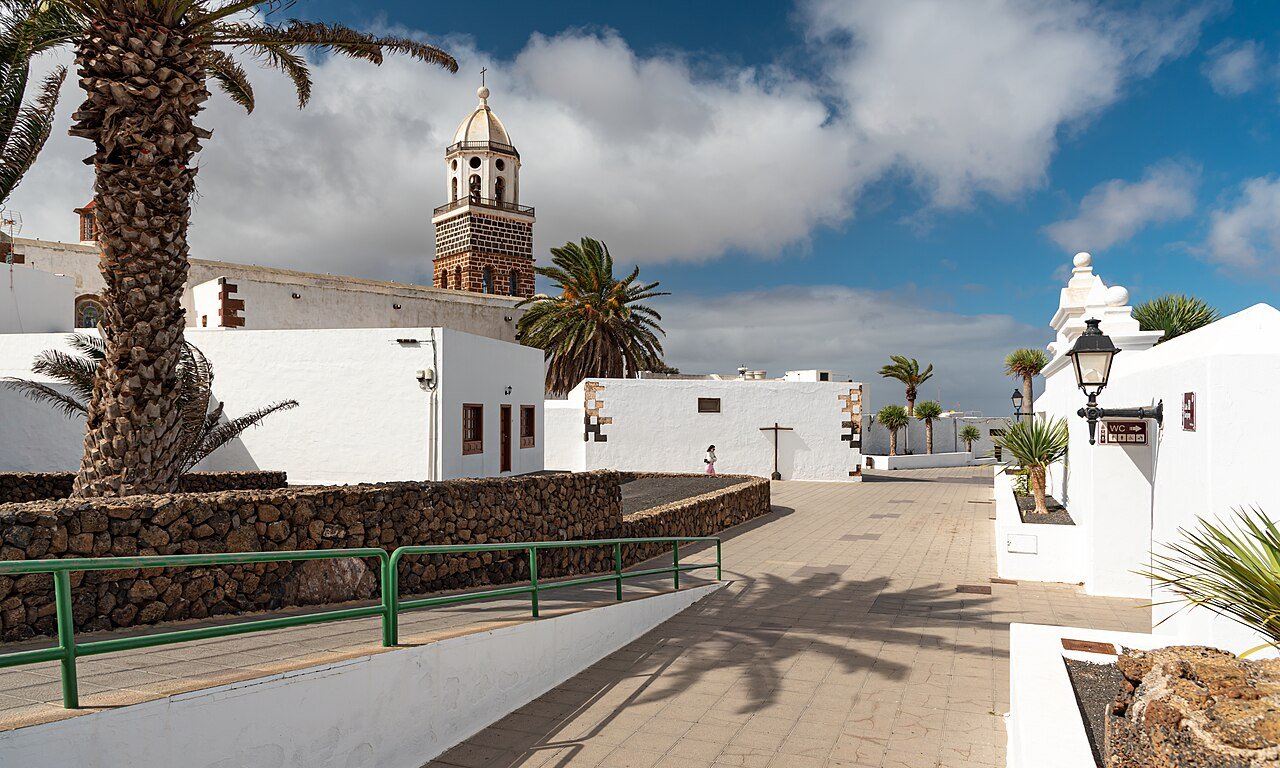
Teguise was the capital of Lanzarote from the 15th century until 1852, when the capital moved to Arrecife. That fact explains the historic weight of the town and its stately layout. It is not merely a pretty inland village, but one of the oldest settlements in the Canary Islands, with origins around 1418 and links to Maciot de Béthencourt. The visit gains depth when seen through its former role as capital: main square, church, mansions, convents and defensive structures all belonged to a place with political and social relevance for centuries. The historic centre preserves an image of white houses and town-scale streets, distinct from the tourist coast of the municipality. The municipality of Teguise also includes Costa Teguise and Caleta de Famara, showing its territorial breadth. The historic town, however, keeps its own identity: inland, patrimonial and tied to Lanzarote’s past.
What to see in the historic centre
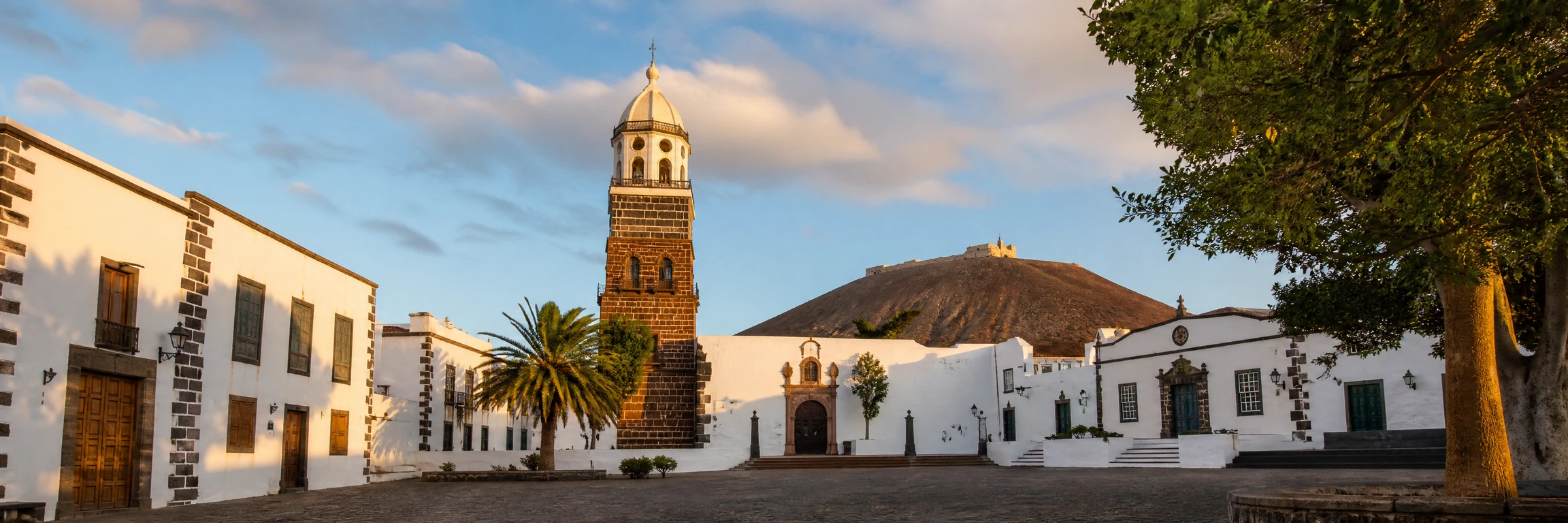
Teguise’s historic centre is organised around a set of clear landmarks. Plaza de la Constitución and the church of Nuestra Señora de Guadalupe form the symbolic heart of the town. Nearby are Palacio Spínola, an 18th-century building now home to the Casa-Museo del Timple, the convent of Santo Domingo, used as an exhibition space, and the convent of San Francisco, which houses the Museo de Arte Sacro. Callejón de la Sangre recalls the pirate attacks suffered by the town, linking the urban walk with Lanzarote’s defensive history. The white mansions give visual continuity to the route and explain why Teguise retains such a noble image. The centre can be visited in a morning if you focus on the old town, but it should not be reduced to the market. Between square, church, palaces, convents and pirate memory, there is enough here to see the former capital with calm.
Castillo de Santa Bárbara and the Piracy Museum
On the edge of the town, on Montaña de Guanapay, Castillo de Santa Bárbara completes the historical reading of Teguise. The building houses the Museo de la Piratería and offers wide views, a combination that fits closely with the past attacks also recalled by Callejón de la Sangre in the centre. Its elevated position helps explain its defensive function and the relationship between the inland town and the territory around it. It should not be presented as a simple viewpoint, even though the views are an important part of the visit. The castle adds context to a settlement that served as capital for centuries and needed protection on an island exposed to incursions. For a morning in Teguise, it can work as a natural extension after Plaza de la Constitución, the church of Guadalupe, the convents and Palacio Spínola. Check official information before going.
The Sunday market
Teguise market takes place on Sunday mornings and is the busiest in the Canary Islands. That has a clear practical consequence: arrive early, because parking fills up. The Sunday experience is different from a calm weekday visit. The town gains movement, stalls and crowds, but loses part of its usual stillness. It is worth deciding what you want before you go. If you want to see the market, Sunday morning is the time. If you prefer to read the historic centre more slowly, it may be better to separate the heritage visit from the busiest day. Combining the old town and market on the same Sunday morning can still be worthwhile. In any case, the market does not replace Teguise: it adds to a town of square, church, convents, museums and former-capital memory. Planning depends on that contrast.
Practical Teguise: parking and when to go
The most important practical decision in Teguise is when to visit. On Sunday mornings, the market draws large numbers and parking fills up, so arriving early is not a decorative tip but a way to avoid complications. If your priority is the historic centre, consider visiting at another time to walk more calmly through Plaza de la Constitución, the church of Nuestra Señora de Guadalupe, Palacio Spínola, the convents and Callejón de la Sangre. If the market interests you, expect a busier atmosphere and allow extra time for parking. Castillo de Santa Bárbara, on Montaña de Guanapay, lies just outside the town and can complete the morning with the Museo de la Piratería and broad views. Teguise works well as an inland visit, different from Costa Teguise and Caleta de Famara even though they belong to the same municipality.
FAQ
Questions about Teguise, the former capital of Lanzarote
What day is Teguise market?
Teguise market takes place on Sunday mornings. It is the busiest market in the Canary Islands, so arriving early is advisable because parking fills up and the historic town changes rhythm significantly that day.
Why did Teguise stop being the capital of Lanzarote?
Teguise was the capital of Lanzarote from the 15th century until 1852. That year the capital moved to Arrecife, the island’s current capital. For the specific reasons behind that change, consult official historical documentation on the town.
What can you see in Teguise in one morning?
In one morning you can visit Plaza de la Constitución, the church of Nuestra Señora de Guadalupe, Palacio Spínola, the convents of Santo Domingo and San Francisco and Callejón de la Sangre. If there is time, go up to Castillo de Santa Bárbara.
Make the most of your visit
Tickets, tours and activities
There are excursions, guided tours and activities in Lanzarote to round off your visit to Teguise, la antigua capital de Lanzarote.
See tours and activitiesKeep exploring
More to see in Lanzarote
Tours and activities in Lanzarote
Loading tours…