Canarias.app travel guide · Gran Canaria
Firgas, Gran Canaria: guide to the water town
Firgas is the water town of northern Gran Canaria: a short, highly rewarding visit for the Paseo de Gran Canaria, Paseo de Canarias, San Roque, the water mill and viewpoints over the ravines. It is its own municipality, not part of Arucas, and combines very well with Teror, Moya or Arucas itself.
What it is and why go
Firgas is a municipality in its own right in northern Gran Canaria, small in size but strongly associated with water. The town hall presents it as Villa de Firgas, the water town, and that idea is not just branding: the centre preserves promenades, irrigation channels, references to springs and a landscape of green ravines that sets it apart from other northern towns. The visit is short and easy if you plan it well: you do not need a full day, but you do need one or two unhurried hours to walk through the centre, see the tiled promenades, look out from San Roque and visit the mill. Firgas suits anyone looking for a photogenic, calm and simple stop to combine with Arucas, Teror, Moya or a route through the northern midlands. It is not a town of major museums or beaches; its value lies in scale, water, stone, landscape and the feeling of a balcony over the north of the island.
The essentials of Firgas
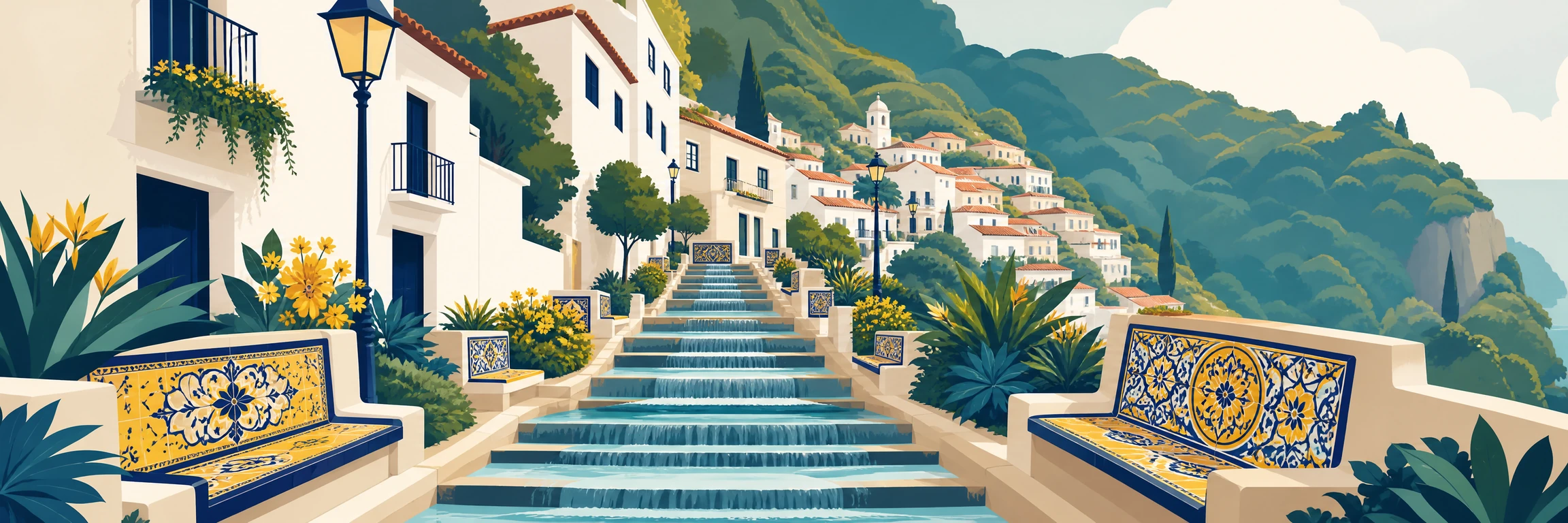
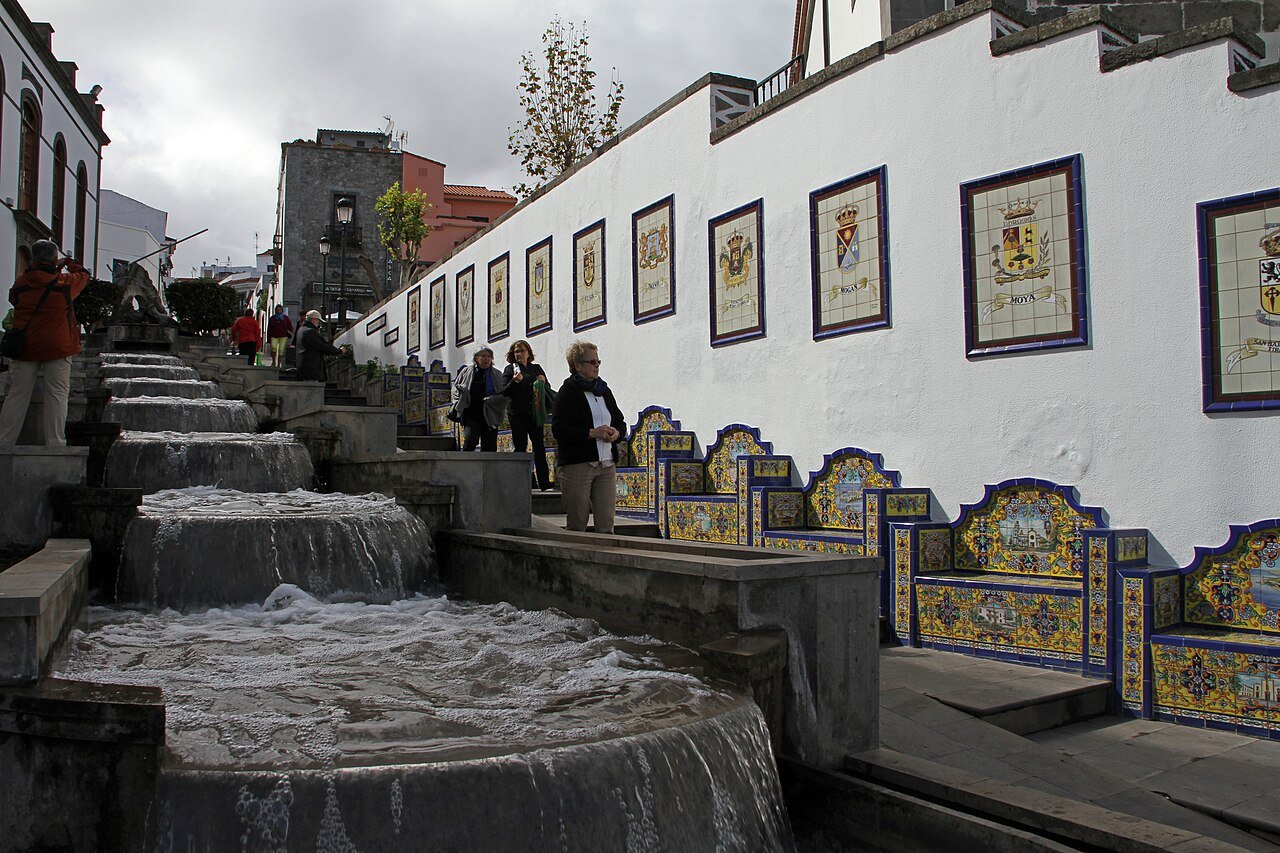
The best-known spot is the Paseo de Gran Canaria, a sloping pedestrian street where the gradient was used to create an approximately 30-metre cascade in quarried stone. Alongside it are the coats of arms of Gran Canaria’s municipalities and the island coat of arms. Connected to it is the Paseo de Canarias, with the seven islands sculpted into the ground, plus coats of arms and representative landscapes. Plaza de San Roque brings together the town hall, the church and one of the best-known views of the centre. The Casa de la Cultura, a former hotel or inn linked to the Azuaje baths, still carries symbolic weight in the town. Another must-see is the Molino de Agua de Firgas, or Molino del Conde, built in 1512 and restored for visits: it sums up the relationship between water, grain and gofio. If you want nearby nature, look towards Las Madres, Azuaje and the municipality’s viewpoints, but check trail conditions before improvising.
Where to eat and what to try
Firgas has the cuisine of the midlands: watercress, potatoes, vegetables, meats, local cheeses, gofio and mineral water, still and sparkling. The municipality itself highlights watercress stew as one of its popular dishes, associated with the growing areas around San Antón and Azuaje. For lunch, think simple Canarian restaurants rather than a large-scale gastronomic scene. If you go at lunchtime on a weekend, book or call ahead, because many visitors link Firgas with Arucas or Teror and end up looking for a table at the same time. Firgas water is a brand closely tied to the town’s image, but do not plan the visit around the bottling plant: for travellers, the interest lies more in water culture, the promenades, the irrigation channel and the memory of the old Azuaje baths. For local produce, ask for spoon dishes, cheeses, gofio and simple desserts from the area.
How to get there and move around
Firgas is in northern Gran Canaria, between the municipalities of Arucas, Moya, Valleseco and Teror. From Las Palmas de Gran Canaria, you can reach it via the northern corridor and inland roads, usually connecting through Arucas or routes that climb towards the midlands. A car is the most convenient option if you want to combine several towns in one morning. There are bus connections towards the north, but frequencies may not fit a tourist route made of short stops; check Global timetables before setting off. Within the centre, walk. The main points are close together, although the promenade and nearby streets are sloped. Parking may require a loop or two on busy days, so do not try to leave the car right beside the cascade. If you travel with reduced mobility, note that the main attraction runs along an inclined street: it can be seen, but it is worth choosing the access point and pace carefully.
Local tips
Firgas is worthwhile if you set expectations correctly: it is a short visit, not a full-day excursion. Spend time on the Paseo de Gran Canaria and Paseo de Canarias, but do not stop at the cascade photo alone; go up or down slowly, look at the tiles, the square and the views. On a clear day, the Las Madres viewpoint and other points nearby help explain why water and ravines matter so much to local identity. If it is raining or has rained recently, ask before heading onto trails around Azuaje or Las Madres, as the ground can become difficult. The most logical combination is Firgas plus Arucas, Teror or Moya, depending on your route. And a common clarification: Firgas does not belong to Arucas. It is an independent municipality, although it borders Arucas and shares with it the hydraulic history of the Heredad de Aguas de Arucas y Firgas, whose historic headquarters still stands in Arucas.
FAQ
Questions about Firgas, Gran Canaria
Is Firgas worth visiting?
Yes, if you want a brief, attractive and easy stop in northern Gran Canaria. The Paseo de Gran Canaria, Paseo de Canarias, San Roque and the mill justify the visit. It is not a whole-day plan, but a one- or two-hour route.
What can I see in Firgas if I have little time?
Start with the Paseo de Gran Canaria and its cascade, continue along the Paseo de Canarias, go up to Plaza and Iglesia de San Roque and visit the Molino de Agua if it fits. With more time, add viewpoints or the Las Madres area.
Does Firgas belong to Arucas?
No. Firgas is an independent municipality of Gran Canaria. It borders Arucas and shares hydraulic history through the Heredad de Aguas de Arucas y Firgas, but administratively it does not depend on Arucas: it has its own town hall.
How long does it take to see Firgas?
For the main centre, allow between one and two hours, depending on photos, pace and whether you include the mill area. If you add lunch, viewpoints or nearby trails, it becomes a relaxed half-day outing in the north.
Which towns combine well with Firgas?
Firgas combines very well with Arucas, Teror, Moya or a route through the northern midlands. If you are coming by car from Las Palmas, you can organise a morning with two towns and lunch without adding unnecessary kilometres.
Make the most of your visit
Tickets, tours and activities
There are excursions, guided tours and activities in Gran Canaria to round off your visit to Firgas.
See tours and activitiesKeep exploring
More to see in Gran Canaria
Tours and activities in Gran Canaria
Loading tours…